
LSU Vet Med alumni prepare Louisiana undergrads for a future in veterinary medicine
May 21, 2026
Helping to lead the pre-veterinary program at Louisiana Tech University in Ruston, La., Drs. Barbara Still and Adam Handy work as a team advising, training, and teaching some of tomorrow's veterinary students.
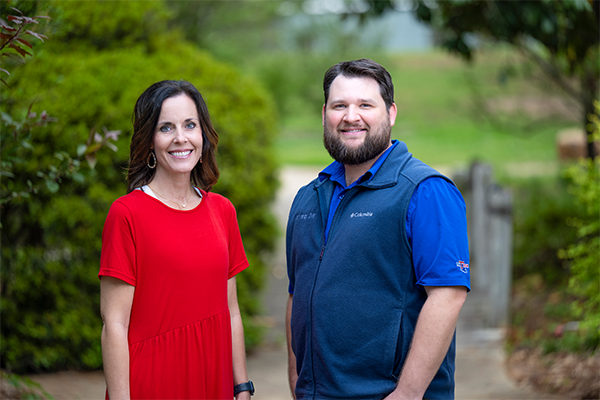
Drs. Barbara Still and Adam Handy, assistant professors at Louisiana Tech University and LSU Vet Med alumni.
Their ultimate goal is to create the most competitive veterinary school applicants possible, a goal they have been successfully achieving so far. Over the last five application cycles (2022 to 2026), a total of 78 Louisiana Tech students got accepted into veterinary schools across the U.S., with 77 percent of those accepted students electing to attend LSU Vet Med.
“Dr. Still and I are two different people and there are students that she will speak to in their language in a way that I never could. And the opposite is true as well,” Dr. Handy said. “I think that collaboration we have as veterinarians and people really helps our students.”
Every academic quarter, Drs. Still and Handy take great pride in advising around 60 students, monitoring their schedules and grades while fostering student success toward a career in veterinary medicine.
“We really get to know the students well and, as they go on to apply to veterinary school, we are typically the ones who will write their recommendation letters," Dr. Still said. “I’ve had students ask me work-life balance questions like how I practiced vet med while having a family.”
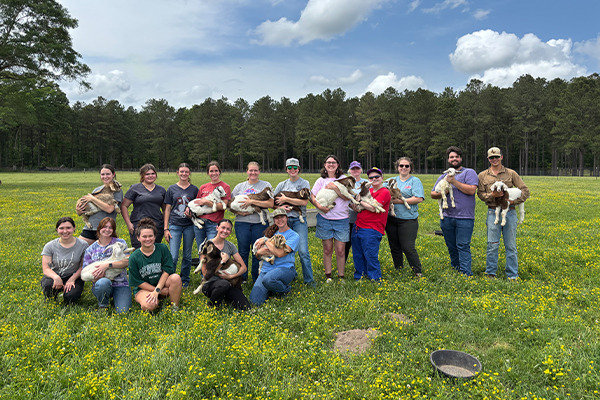
Students in Dr. Still’s sheep and goat production class participated in a hands-on lab where they practiced vaccinating, deworming, castrating, and hoof trimming at a local farm.
Many of their students are in the same position Drs. Still and Handy once were. Both earned their undergraduate degrees through Louisiana Tech’s pre-veterinary program, where they even shared the same two mentors, Dr. William Green, who is now retired, and Dr. Mark Murphey, a long-time professor and department head of Louisiana Tech’s Animal Science program.
They later attended LSU Vet Med, with Dr. Still graduating in 2002, and Dr. Handy graduating in 2012. Then, in 2024, both returned to Louisiana Tech to teach and lead the same pre-veterinary program that helped shape their own careers.
“I went through this program myself. It’s nice to be in a place where I can take the best of what people gave me while I was in the student chair and use that in my teaching now,” Dr. Handy said.
While the program had only one veterinarian on faculty, it has since expanded to two. Louisiana Tech also recently added animal nutritionist Dr. Emmanuel Oladejo to round out the animal science team.
“In the past while students might have had to wait until their junior year for veterinary courses, we are now able to broaden that net to include those interested,” Dr. Handy said.
After graduating from LSU Vet Med, they both practiced as clinicians before returning to Louisiana Tech to teach. Together, they bring their real-world experiences with them into the classroom.
“As clinicians, we are able to bring real-life cases into our lectures. I use radiographs, teach students how to write medical records, and use suture kits. We’ve recently purchased a palpation simulator,” Dr. Still said. “I feel like having a veterinarian as a professor gives a different perspective, the students seem to respond differently when we bring up real-life cases.”
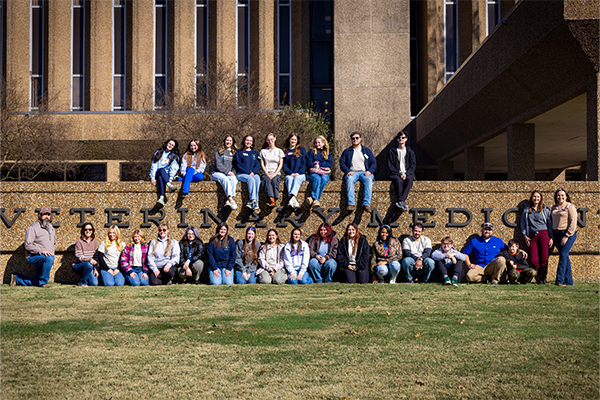
In January, Louisiana Tech’s pre-veterinary club, along with Drs. Still and Handy and longtime club advisor Gordon Reger visited LSU Vet Med for a tour and admissions advising with Dr. Gretchen Delcambre. Fourth-year student and Louisiana Tech alumna, Courtney Wingate, helped guide the visit.
They each bring their own expertise to the job. Growing up on a farm in Athens, La., Dr. Still has experience in livestock production, a major focus of Louisiana Tech’s pre-veterinary program. While Dr. Handy also grew up in a small town in Louisiana, Collinston, he practiced in Utah for the past decade, most recently teaching at a local veterinary technician school.
They split the animal science coursework, with Dr. Still teaching the livestock production courses and Dr. Handy teaching the veterinary science base courses.
“For the most part we are a livestock and large animal science program which is great because that is the sector in which there is a national veterinarian shortage in right now,” Dr. Still said. “Most of the courses we teach have hands-on labs that go with the lectures, that focus on skills such as safety and handling, drawing blood samples from various species, giving injections, and teaching how to perform physical exams.”
They work together, making sure their students get the most comprehensive education possible. If Dr. Still doesn’t feel like she covered a topic adequately, she will ask Dr. Handy to cover it again in his classes. “We are focused on the student’s education as a whole and not just separate courses and terms,” Dr. Still said.